


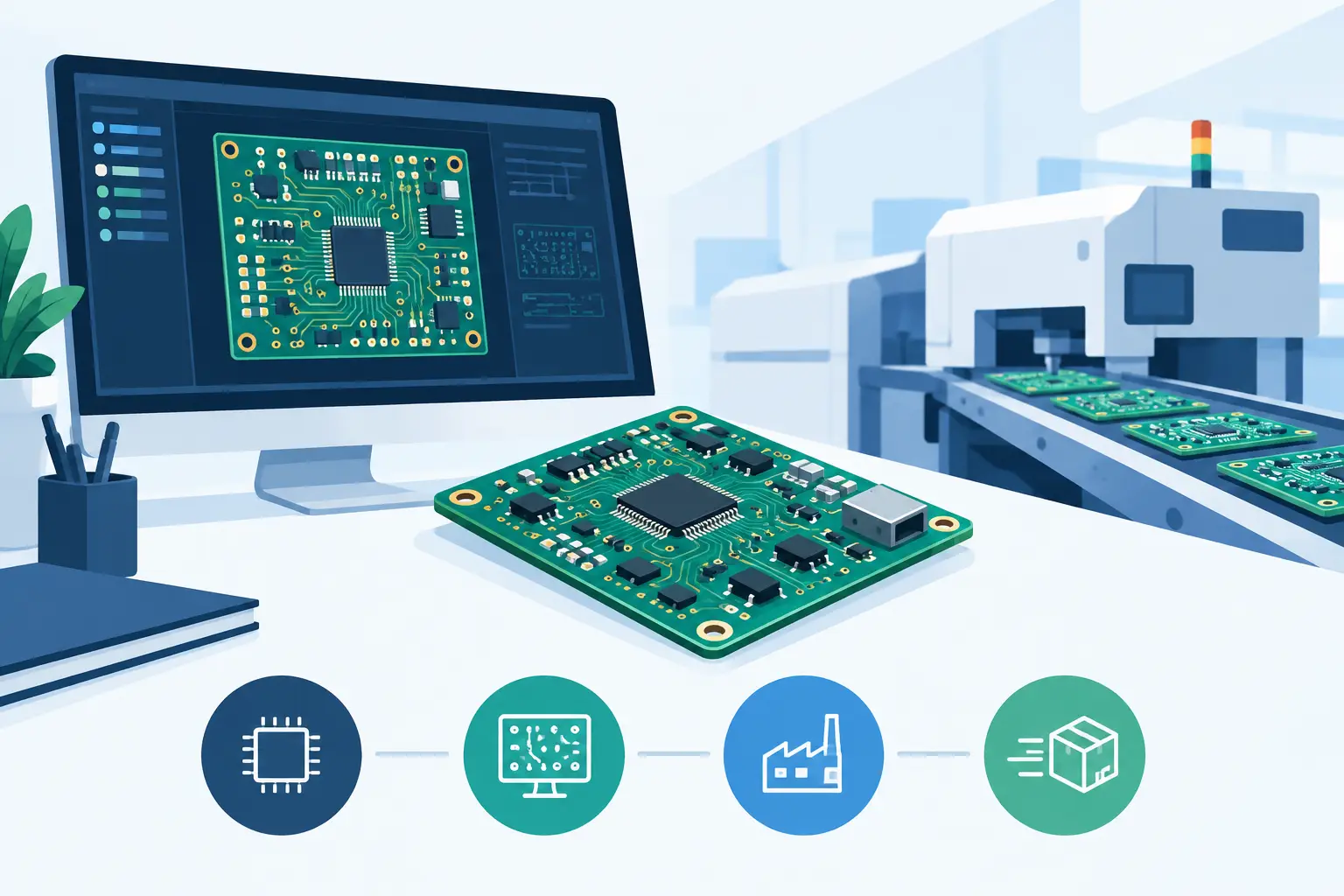
A PoE tablet that resets when a door strike activates, a kiosk that overheats in direct sun, or a panel PC that cannot pass EMC testing all point to the same problem: the board was designed around a feature list instead of its operating environment. Custom PCB design services address that gap by turning electrical, mechanical, software, and production requirements into hardware that can be deployed and supported at scale.
For OEMs, systems integrators, and product teams, the goal is not simply to create a PCB that works on a bench. It is to build a board that fits the enclosure, supports the intended operating system and peripherals, can be manufactured consistently, and remains available through the product lifecycle. That requires decisions well beyond component placement.
What Custom PCB Design Services Should Deliver
A capable custom PCB program begins with the deployment model. A wall-mounted Android terminal, a vehicle computer, a biometric time clock, and an outdoor payment kiosk may all use touch displays and embedded processors, but their electrical constraints are different. Power input, heat dissipation, connector retention, radio performance, ingress protection, service access, and expected operating hours all affect the board architecture.
The design process should establish the system before schematic capture starts. That includes processor selection, memory and storage requirements, display interface, power budget, Ethernet or cellular connectivity, USB and serial expansion, audio, cameras, RFID or NFC modules, barcode scanners, biometric sensors, and security features. It also identifies what must remain configurable as the product moves from prototype to customer-specific variants.
For industrial hardware, a board needs clear answers to practical questions. Will it run continuously in a restaurant kitchen or factory? Does it need 802.3af or 802.3at PoE power? Can a field technician replace a cable without opening the entire enclosure? Is the display powered from the same rail as the compute module? Does the design need wide-temperature components, ESD protection at external ports, or isolated I/O for equipment interfaces?
A good engineering partner documents these decisions early. This reduces late changes that can add cost, delay certification, or force a mechanical redesign.
Design for the Installed Environment, Not Just the Lab
Many embedded products fail because the board specification ignores where the product will be installed. A compact board may look efficient until it is enclosed in a sealed IP65 housing, mounted on a sun-facing wall, or subjected to vibration in a fleet vehicle. Thermal behavior, antenna placement, connector loading, and power stability must be evaluated in the full system.
Power Architecture Drives Reliability
Power is often the first constraint to review. PoE simplifies installation by carrying data and power over one Ethernet cable, but it also requires careful planning for classification, isolation, surge protection, cable loss, and peak load. A touchscreen terminal can draw much more current at maximum display brightness, during processor load spikes, or while charging a connected peripheral.
The same principle applies to DC-powered systems. Input protection, reverse-polarity protection, transient suppression, battery behavior, and shutdown sequencing should match the field environment. A vehicle-mounted computer, for example, must tolerate electrical conditions that are not present in an office installation.
Mechanical and PCB Engineering Must Move Together
A PCB cannot be finalized independently from the enclosure. Board outline, mounting points, display stack-up, heatsinks, gasket paths, antenna windows, cable routing, and access to debug or service connectors all influence the layout. Tight coordination also prevents common production issues, such as a connector that is technically correct but inaccessible after assembly.
For white-label hardware, this coordination makes product variants more practical. A common core board can support different bezel designs, camera options, reader modules, branding, or mounting methods without requiring a complete redesign for every customer program. The trade-off is that the initial architecture needs enough foresight to support controlled variation without becoming unnecessarily expensive.
Custom PCB Design Services Need a Manufacturing Path
A prototype that powers on is not automatically ready for controlled production. The transition to manufacturing requires component sourcing, panelization, assembly constraints, test coverage, programming methods, inspection criteria, and revision control. These are not downstream tasks. They should influence component and layout choices from the beginning.
For example, a part may meet the electrical specification but have uncertain availability or a short lifecycle. A package may save board area but complicate rework or inspection. A design with limited test points may be difficult to troubleshoot during production. For products expected to remain in service for years, these issues can create much larger costs than the original PCB layout effort.
A production-focused engagement typically includes a bill of materials strategy, approved alternates where appropriate, design-for-manufacturing review, assembly documentation, and functional test planning. Depending on the device, testing may verify display output, touch response, Ethernet and PoE negotiation, wireless performance, USB operation, RFID reads, audio, camera functions, and programmed firmware identity.
Geekland approaches custom hardware as an integrated product program, combining board design with enclosure engineering, embedded firmware, prototype builds, controlled manufacturing, and compliance support. That approach is especially useful when the product is a complete terminal rather than a standalone board.
Certification Should Shape the Hardware Early
FCC, CE, and product-specific compliance work can expose issues that are expensive to correct after tooling and pilot production. Electromagnetic emissions, immunity, radio integration, creepage and clearance, safety-related power design, material selection, labeling, and documentation all deserve early attention.
Certification is not identical for every program. A fixed indoor PoE display has different risks from a cellular-enabled outdoor terminal or a battery-powered mobile device. Android GMS requirements also introduce their own software and hardware validation considerations. The right approach is to identify applicable requirements at the architecture stage, then retain the design records and test evidence needed for the intended market.
Pre-compliance testing is particularly valuable before a formal lab submission. It does not guarantee final approval, but it can identify layout, grounding, shielding, or power-noise problems while changes are still manageable. Teams should budget for iteration because first-pass success depends on the complexity of the system and the maturity of the reference design.
Choosing the Right Level of Customization
Not every deployment needs a fully custom motherboard. In many cases, an existing industrial tablet, panel PC, or display platform can be adapted with branded housings, customized firmware, kiosk mode, selected I/O, reader integration, or an application-specific mounting solution. This route can reduce development time and lower minimum order risk.
A fully custom PCB becomes more compelling when a standard platform cannot meet a required form factor, power method, thermal target, connector arrangement, security feature, or unit-cost objective. It also makes sense when an OEM needs control over its own product roadmap and cannot accept a catalog device changing without notice.
The decision depends on volume, schedule, differentiation, certification scope, and lifecycle expectations. A pilot program with a narrow workflow may benefit from configuring proven hardware first. A product line intended for broad commercial deployment may justify a custom architecture that removes unnecessary features and concentrates cost on the interfaces customers actually use.
Questions to Resolve Before Engineering Starts
The clearest projects begin with a short, specific requirements package. It should define the use case, installation environment, target quantity, deployment regions, expected operating life, desired operating system, key peripherals, connectivity, power source, enclosure constraints, and certification needs. Product teams should also state what is fixed and what can change.
It helps to include the realities that rarely appear on an initial feature list: whether the unit will be cleaned with chemicals, whether gloves are used with the touchscreen, whether network cables may be poorly grounded, whether the device must boot automatically after power loss, and whether technicians need remote management. These details shape the final hardware far more than a generic request for an Android board or an industrial display.
The strongest custom PCB program is one that treats the circuit board as part of an operating system for the physical world. Start with the conditions the device must survive, the people who must install it, and the production process that must repeat it. The resulting hardware is more likely to keep working when the deployment stops being a prototype and becomes everyday infrastructure.