


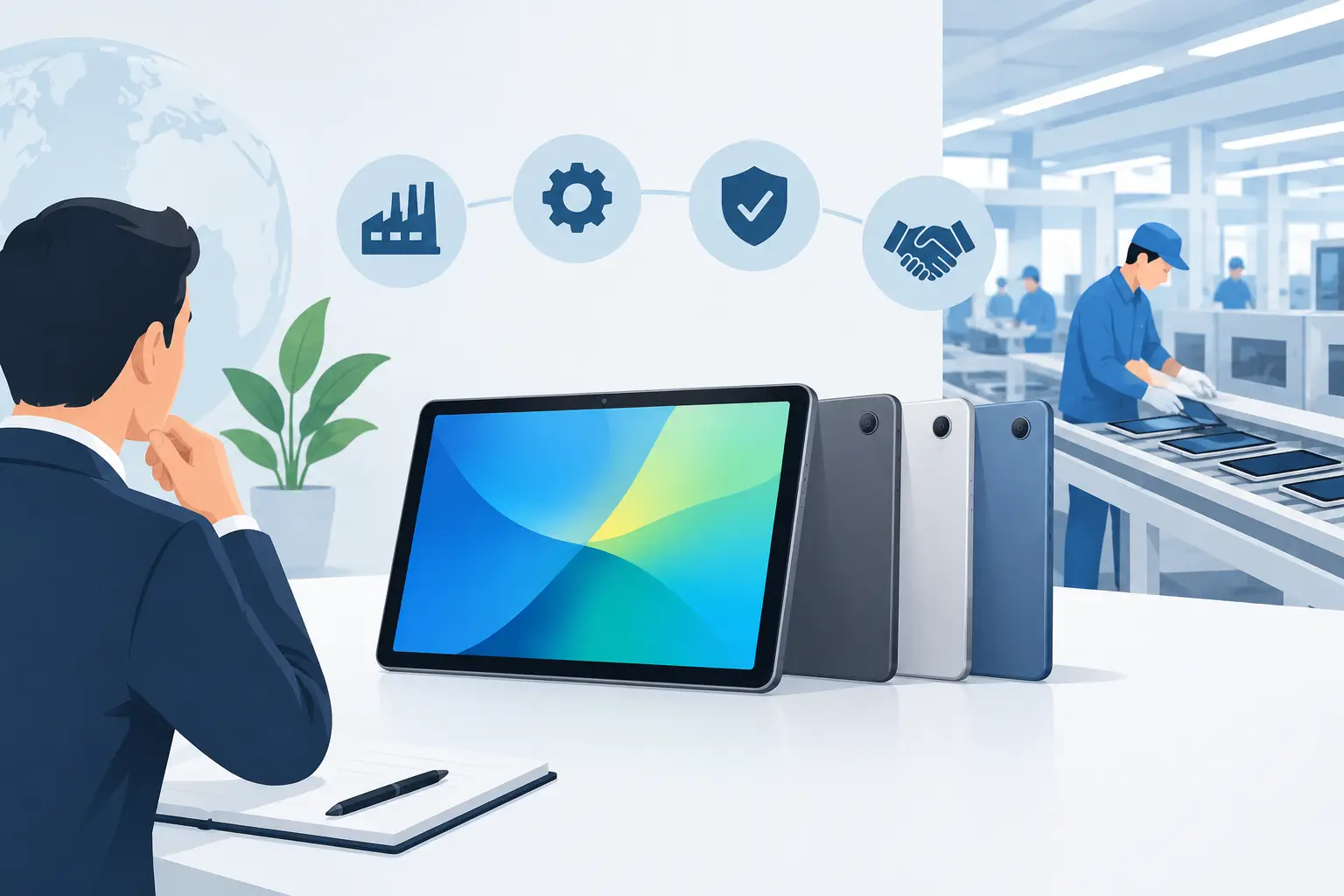
A tablet that looks right in a product sample can become an expensive problem after 500 units reach a factory floor, restaurant chain, or access-control project. The right OEM Android tablet manufacturer does more than assemble hardware. It helps define the device, validate how it will be installed and used, control production quality, and support the product through its operating life.
For B2B buyers, the decision is rarely about finding the lowest unit price. It is about finding a manufacturing partner that can deliver a stable platform for a specific workflow, whether that means a wall-mounted PoE tablet for room scheduling, an IP65 panel PC for production monitoring, or a rugged Android terminal for field data capture.
Start With the Deployment, Not the Spec Sheet
A generic Android tablet is designed for intermittent personal use. An industrial tablet program is usually deployed for a single task, remains powered for long hours, and must tolerate a predictable set of environmental, installation, and support constraints.
Define the operating conditions before comparing processors, screen sizes, or memory configurations. A lobby check-in kiosk has different needs from a warehouse vehicle terminal. A restaurant kitchen display may need splash resistance, wide viewing angles, and a mounting system that can be cleaned frequently. A building-access terminal may need NFC, RFID, a camera, PoE power, and managed kiosk-mode operation.
The installation method is equally important. Power over Ethernet can reduce electrician labor and eliminate the need for a separate power outlet at every device location. For fixed deployments, this often improves consistency and makes replacement easier. However, PoE requires the correct network-switch budget, cable run planning, and power-class verification. It is a practical advantage, not a universal substitute for local power.
A capable manufacturer should ask about environment, mounting, network architecture, expected daily operating hours, peripherals, user interaction, and service access. If the discussion begins and ends with a catalog price, the product definition is probably not complete.
Evaluate the OEM Android Tablet Manufacturer’s Engineering Depth
The word OEM is used broadly. Some suppliers offer light branding on a standard device. Others can engineer a new product around a customer requirement. Both models can be appropriate, but they serve different commercial goals.
For a faster launch with manageable customization, a proven platform may be configured with a custom boot logo, enclosure color, printed branding, application preload, kiosk settings, and selected accessories. This approach can reduce non-recurring engineering cost and lower the risk associated with a completely new design.
A purpose-built program may require deeper work: custom PCB or motherboard design, modified I/O, a new enclosure, specialized mounting points, integrated RFID or barcode scanning, a different display brightness, or tailored thermal management. These requirements call for an engineering organization that can handle electrical, mechanical, firmware, and manufacturing decisions together.
Questions That Reveal Real Capability
Ask who owns the design files, who controls firmware changes, and how the supplier handles component substitutions. Those answers matter more than a polished product brochure.
A qualified partner should be able to explain its process for design for manufacturability, engineering validation, pilot production, and controlled mass production. It should also discuss failure analysis, incoming inspection, burn-in or aging tests where appropriate, and traceability for key assemblies.
For Android products, ask how the operating system image is managed. An industrial deployment may need application auto-launch, disabled consumer settings, remote update support, USB restrictions, fixed orientation, or recovery behavior that does not expose end users to device setup screens. Kiosk mode is not merely an application setting. It is part of the operational design of the device.
Treat Android Software as a Product Requirement
Hardware selection and Android configuration should be planned together. A device can have adequate processing power but still cause deployment issues if its firmware is inconsistent, its peripheral drivers are incomplete, or its update process is unclear.
Start by identifying whether the device needs standard Android, Android with Google Mobile Services, AOSP-based Android, Linux, or Windows. Google Mobile Services may be necessary for applications that rely on Google APIs, managed app distribution, or Play services. It also introduces certification requirements and version-control considerations. In contrast, an AOSP-based build can provide a tightly controlled single-purpose interface when Google services are not required.
The right choice depends on the application and support model. A public kiosk may benefit from a locked-down AOSP configuration. A mobile workforce tablet using commercial enterprise applications may require GMS compatibility and mobile device management support. There is no single Android stack that fits every industrial program.
Firmware ownership should also be explicit. Establish how bug fixes are requested, how software versions are approved, whether over-the-air updates are supported, and how long a selected Android version will be maintained. A manufacturer that can develop and maintain custom ROMs provides more control than one that only ships a factory image.
Verify Industrial Design for the Actual Environment
Industrial claims should be measured against the deployment rather than accepted as generic labels. IP65 or IP67 protection can be valuable in dusty, wet, or washdown-adjacent environments, but the right rating depends on exposure. An indoor wall tablet in a climate-controlled office does not need the same protection as a terminal used near food preparation, loading docks, or outdoor access points.
Display performance deserves similar scrutiny. A 1,000-nit sunlight-readable display can make a major difference in outdoor kiosks, fleet applications, and bright storefront installations. Yet higher brightness can increase power draw and thermal load. A manufacturer should help balance readability, expected ambient light, enclosure design, and long-term panel availability.
Also examine details that tend to surface after deployment: connector retention, mounting strength, speaker volume, microphone performance, serviceable parts, cable routing, and battery policy. For a fixed-install device, a battery may add cost and lifecycle concerns without delivering meaningful value. For a mobile device, battery capacity, charging contacts, and replacement procedures may be central to uptime.
Plan for Compliance and Commercialization Early
Compliance should not be treated as a final paperwork step. Changes to radios, antennas, power architecture, enclosure materials, or a product’s intended market can affect test requirements and project timelines.
For US and international deployment, buyers commonly need to consider FCC, CE, RoHS, and other market-specific requirements. Android GMS certification may also be required depending on the software model. A manufacturing partner should clarify which approvals apply to the base platform, which apply to the finished configuration, and which responsibility remains with the brand owner or integrator.
This is especially relevant for custom hardware. A design that includes Wi-Fi, Bluetooth, cellular connectivity, NFC, RFID, biometric modules, or an external power supply may require a more deliberate compliance plan than a standard tablet. Early review prevents a late-stage redesign caused by antenna placement, emissions, labeling, or documentation gaps.
Protect Supply Continuity After the First Purchase Order
The first production run is only the beginning. Systems integrators and OEM product teams often need the same hardware for years, not months. A tablet that is quietly revised because a processor, display, memory component, or wireless module becomes unavailable can create application, certification, and service complications.
Ask for a lifecycle plan. This should address component availability, approved alternates, end-of-life notification, revision control, and the process for validating any change. For larger programs, consider safety stock for critical components or finished devices. The right inventory strategy depends on forecast confidence, storage capacity, and cash flow, but it should be discussed before shortages occur.
Quality control should be visible as well. A serious manufacturer can describe the production test coverage for touch panels, displays, ports, radios, cameras, charging, PoE negotiation, and peripheral functions. A device intended for 24/7 use should not rely solely on a quick power-on check at the end of the line.
Choose a Partner That Can Scale With the Program
The best engagement model matches the maturity of the project. A standard product with white-label branding may be the fastest route for a facilities rollout. A custom enclosure and ROM may be appropriate for a differentiated commercial product. A full PCB, mechanical, firmware, and certification program is justified when the hardware itself creates competitive value or solves a unique installation challenge.
Geekland supports this range, from configurable industrial Android hardware to purpose-built OEM and ODM programs that combine enclosure engineering, embedded software, controlled production, and compliance support. The practical objective is not customization for its own sake. It is to build only the changes that improve deployment, serviceability, product differentiation, or total cost of ownership.
Before committing, request a sample that represents the proposed production configuration, not merely a similar catalog unit. Test it with the real application, network equipment, mounts, peripherals, lighting conditions, and cleaning procedures. Then document what happens when power drops, connectivity fails, a user attempts to exit the application, or a device must be replaced in the field.
A good manufacturing partner will welcome that scrutiny. The right tablet program is built around the moments when the device is under pressure, because that is where hardware either becomes dependable infrastructure or creates another support ticket.